Scientific name: Contia tenuis PDF version of this page
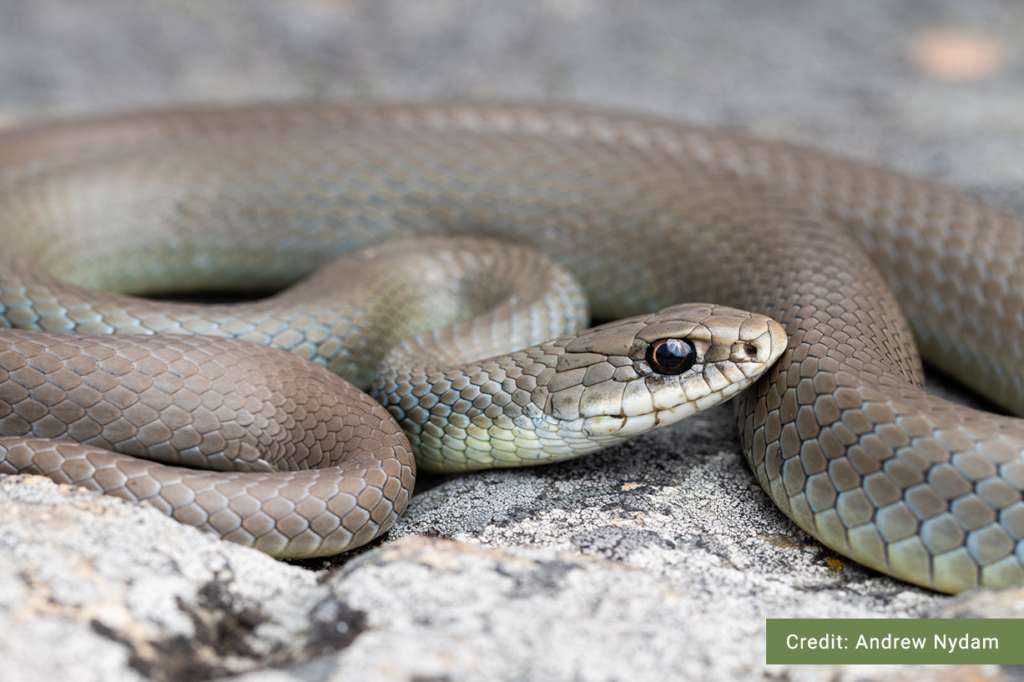
The Sharp-tailed Snake is a small snake, reaching a maximum length of only 20 to 45 cm. On average, they are about as thick as a pencil. Their small size, nocturnal activity, and secretive nature make them one of B.C.’s least understood reptiles.
The name “sharp-tailed” comes from the sharply pointed scale at the tip of the short tail. Adults are grey, yellowish brown, or red in colour. Usually this colour is interrupted by a wide yellowish stripe along each side. Some individuals also have a dusting of fine black dots over the body. The belly is pale with dark bars along the bottom of each scale. The head is wider than the neck, the nose rounded or squared off, and they usually sport a black mask over the eyes. Juveniles tend to be more vivid in colour, and the entire back may be orange or red (as seen in this photo).
Click here to visit the Sharp-tailed Snake Photo Gallery.
Because of the Sharp-tailed Snake’s secretive nature, not much is known about its life history in B.C. They likely hibernate during the winter, and mate after they emerge from their dens in the fall. They are found in relatively high numbers in spring and fall, which may make them more vulnerable to disturbance during these periods. Sharp-tailed Snakes are oviparous, that is, their young develop in eggs outside of their mother’s body. Females are thought to lay between 2 and 9 eggs in late spring to early summer, and the young hatch sometime in autumn. The eggs are laid in communal egg laying sites. These sites can be cracks between rocks, underground, or clumps of grass roots.
Sharp-tailed Snakes seem to behave more like amphibians than reptiles! During the heat of the summer they largely are inactive, and may estivate (stop eating and reduce their activity) underground during July and August.
Sharp-tailed Snakes likely are easy prey for predators such as birds, Western Terrestrial Garter Snakes, raccoons, mink, and shrews. Hatchling Sharp-tailed Snakes may curl into a tight ball when threatened, making it difficult for predators to swallow them. Adult Sharp-tailed snakes thrash side to side when handled by humans, and push their tail spine into the skin of their handler. This is more startling than painful, and it may distract potential predators enough to allow for escape.
Sharp-tailed Snakes specialize in small slugs! They have elongated teeth that help them handle their slippery suppers. Little is known about other possible food preferences of this species.
Sharp-tailed Snakes are found in pockets of Coastal Douglas-fir and Arbutus forest on Vancouver Island and the Gulf Islands. Only one record exists of a Sharp-tailed Snake outside of this area. This one individual reportedly was found at McGillvray Lake in the southern interior, in an Engelmann Spruce-Subalpine Fir habitat.
Sharp-tailed Snakes are almost always found in relatively open, moist woodlands and forests, especially near streams. Individuals spend most of their time under rocks and rotting woody material. They often are found near secluded south facing rocky slopes. This appears to be critical habitat, likely because it provides both hibernacula and egg-laying sites.
Click here to see the Sharp-tailed Snake Range Map.
Sharp-tailed Snakes are found in very few areas, in very low numbers, in habitats that are rapidly disappearing. For this reason, Sharp-tailed Snakes are red-listed in B.C., and considered endangered by the federal Committee on the Status of Endangered Wildlife In Canada (COSEWIC). If you see a Sharp-tailed Snake, please contact your local branch of the Ministry of the Environment.
Exactly why this species is so rare is not well understood. Currently, urban sprawl and deforestation are its greatest threats. Some snakes are killed by cars and predated upon by domestic pets such as cats. While these factors may be threatening current populations, some scientists feel that the Sharp-tailed Snake likely was never very abundant in B.C. Existing individuals may be left-over or relict populations from a formerly more extensive population that shrank southward with the cooling and warming trends of North America.
In B.C., the Sharp-tailed Snake is at the northern limit of its range, limiting its reproductive opportunities and expansion into other habitats. However, it is important to conserve the populations that remain. This unique slug-supping snake is an important (and fascinating) part of our province’s biodiversity.